The Manifesto Project provides the scientific community with parties’ policy positions derived from a content analysis of parties’ electoral manifestos. It covers over 1000 parties from 1945 until today in over 50 countries on five continents. The DFG-funded MARPOR project continues the work of the Manifesto Research Group (MRG) and the Comparative Manifestos Project (CMP). On this website you find the Manifesto Project Dataset containing the parties' policy preferences generated by the project. You also find coded and uncoded election manifestos of the parties in the dataset as well as information and links to many applications for the dataset, related projects and publications etc.
Coded manifestos available through the Manifesto Corpus: The Corpus publishes the digital codings on the quasi-sentence level the project has produced since 2009. It allows users to verify and check our codings, recode the data for their own purposes, create new subcategories, use them for automatic analysis, etc.
Release of manifestoR: an R packages facilitating use and access of the Manifesto Project Data.
Update 2015a available: It is the first dataset that reports data coded on the basis of the new category scheme. Check Version 5 of the coding instructions to learn more about the new category scheme. For everyone doing over time comparisons the dataset also reports the data aggregated into the old category scheme.
First data from South American countries published: This new dataset will provide data on South American parties and presidential candidates. So far it contains data from Argentina, Brazil and Chile, more countries and elections will follow.
New update of the Manifesto Dataset (2020a)!
First Highlight:
We added 9 elections to the Main Dataset:
BIH 2018 CHE 2019 ESP 2019(April) FIN 2019 GBR 2019 MEX 2018 POL 2015 SVN 2018 UKR 2012
Also included are the already coded Flemish manifestos of the Belgium 2019 election.
Does "rally-around-the-flag" work equally for all parties? Using among others @manifesto_proj data @osman_s_kiratli shows that voters react differently to military conflicts before elections, depending on the foreign policy orientation of the gov. party.
https://journals.sagepub.com/doi/full/10.1177/1354068820939777
Something for data gourmets: You can now download the government declaration dataset, a classic that was originally published with MPP I (on a CD!). If you are interested in policy preferences of governments you should definitely take a look: https://manifesto-project.wzb.eu/information/documents/gdds
Second episode of „how to hand over job positions during #StayAtHome“. @TobiasBurst succeeds @krause_we as a MARPOR fellow, who joins the Comparative Politics department at @HumboldtUni as a Post-Doc. We wish both of you a great start! https://t.co/y8obku6SdF
No April fool: We are proudly presenting: how to hand over job positions in home office. (part I) We are happy to announce that @tionde_lisa becomes a MARPOR fellow and takes over from @TheresMatthiess, who joins MZES as a postdoc fellow. Have a great start both of you! https://t.co/aOWXeBYhmW
It's been a while, but today is #tutorialthursday again!
In our new tutorial, you can learn how to recode and extend our coding scheme with self-defined categories: https://manifesto-project.wzb.eu/tutorials/recoding
Written by: @tionde_lisa and Paul Muscat https://t.co/XL7sdnQ885
Two more weeks to apply and to become a member of our team!
👇👇👇 https://twitter.com/manifesto_proj/status/1207569341346189312
Christmas gift from us: We released new versions of our datasets (2019b)!
We added six elections: BR 2018, DK 2015, FI 2015, IS 2017, LV 2018, NO 2017.
Happy holidays and have fun with the data!
Check out: https://manifesto-project.wzb.eu/datasets
We have an open research fellow position for 2 years!
Start Date: 1 March 2020
Perfect for preparing or completing a dissertation in the research areas of elections, parties, or representation.
Application Deadline: 27 January 2020
https://wzb.eu/en/jobs/research-fellow-fmx
Attention: [2019-11-21] Our server (website and api) will be down due to power cutoff from tomorrow (the 22nd) 5pm (MEZ) for (hopefully) maximum 72 hours. Sorry for the inconvenience. https://t.co/ZPJhKxuF58
What are the programmatic success strategies of radical left parties in Western Europe? And how do the positions of Social Democrats influence these strategies?
Our research fellow @krause_we investigates these questions in his freshly published @WEPsocial article.
👇👇👇 https://twitter.com/krause_we/status/1192010527645585409
Using @manifesto_proj data, @pstanig and Italo Colantone investigate how economic shocks can explain the surge of radical-right parties and how this relates to the cultural backlash hypothesis!
Out in the Journal of Economic Perspectives @AEAjournals
https://www.aeaweb.org/articles?id=10.1257/jep.33.4.128 https://t.co/aaY8yEx1Qg
Do political parties programmatically respond to the electoral success of radical right parties beyond immigration?
Our fellow @krause_we shows that this indeed the cases: Left parties promote more generous welfare positions.
Read the article here: https://www.tandfonline.com/doi/full/10.1080/00344893.2019.1661871 https://t.co/1WYkgfTwPR
New Data!
Check out our homepage (https://manifesto-project.wzb.eu/) and the release notes (https://manifesto-project.wzb.eu/down/data/2019a/codebooks/release_notes_MPDS2019a.pdf) for more information.
Added elections: SWE 2019 ISL 2016 BEL 2014 ITA 2018 NZL 2017 TUR 2018 LTU 2016 MKD 2016 SVN 2016
Great news! Congratulations! Looking forward to having one of our Steering Group members so close by. 👏 https://twitter.com/ThomasMMeyer/status/1153345373768945665
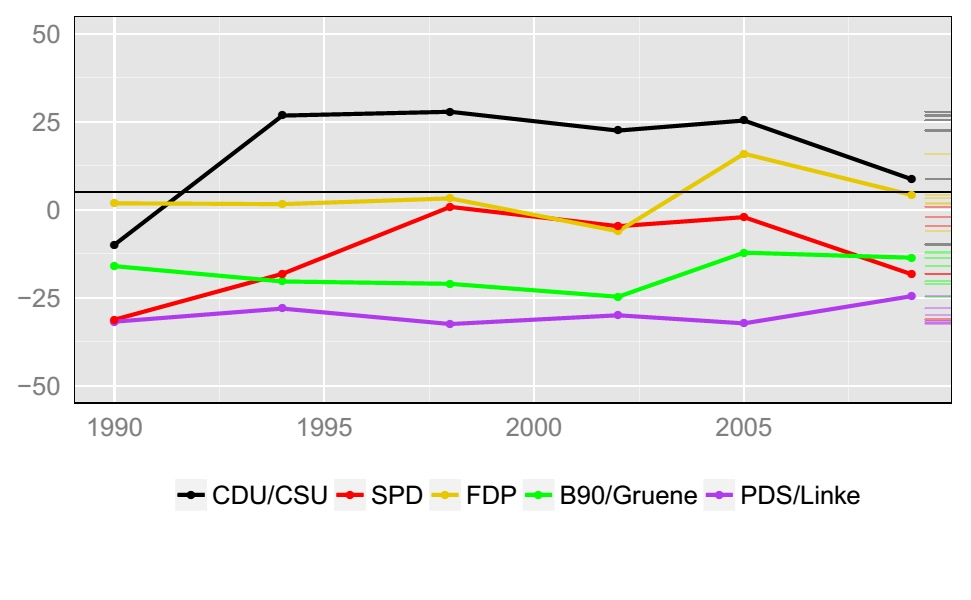
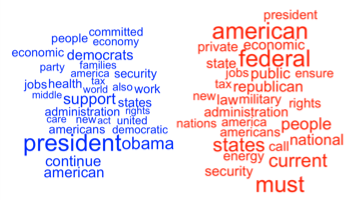
The @nytimes uses @manifesto_proj data to show how the positions of Republicans and Democrats evolved over time. Strikingly, the Republican Party under Trump is on a par with some West European radical right parties according to its programmatic profile.
https://www.nytimes.com/interactive/2019/06/26/opinion/sunday/republican-platform-far-right.html
If you use any of the data you find on this website, please cite us. You find the correct citation for all datasets on all download pages. If you use the documents, please cite the Manifesto Corpus.